Showing posts with label elearning. Show all posts

Tuesday, March 21, 2017

Seesaw wish list...


I knew that Seesaw was a great tool when I first saw the (at the time) innovative QR login. Here was a company that seemed to understand that creating a tool that is easy to use for students will in turn make it easier for teachers.
After using as a school admin, teacher and parent, I now have a few ideas of where the next innovation could be;
    Image result for badge up level
  1. 'Gamification' and simple teacher posts. Imagine a bank of 100+ badges that teachers could assign to students in seconds...(aka Class Dojo). Yeah, it only takes 30 seconds to post 'Joe moved up Reading Level's today. He has been working really hard and we are all really proud of him' but imagine a badge like this that teachers select and assign. And if Seesaw can go there with badges, it could be pretty simple to gamify it, with a points/badge system for some real student motivation!
  2. The ability for parents to post into connected students journal. The very idea of the name 'Seesaw' is going back and forward between home and school. What better way to allow for this to happen than the ability for a parent to post into a child's account, either with their child or independently? I could see families on an overseas trip using Seesaw as an 'online journal' to share their discoveries, or 'family home learning tasks' where challenges are set (e.g. 'go on a nature walk') and completed and posted on Seesaw. 
  3. Parents to be able to invite other family members and manage connected adults. The QR letter Seesaw generates is genius, but getting this letter to Nana on the other side of the world is not so easy, nor is it necessarily easy for Nana to connect up, even if she does have the letter (Nana looking in the Yellow pages for 'App Store'....). I would love to see an 'invite family member' button that connected parents (who have used the QR code from school) can click on to generate a link for family members that allows a 'click on this link and join into this child's Seesaw account'. In correlation with this idea, it would make sense for the first parent that connects to the child (through the QR letter) to be able to manage other connected adults. How is a teacher supposed to know if Joe Bloggs is really someone's uncle?
  4. 'Learning Task creation'. As it stands, I recommend using Seesaw alongside either Google Classroom or Hapara Workspaces. I would love to see Seesaw go into the 'task creator space' whereby teachers can post and manage learning tasks within Seesaw. It would need its own section ('Learning/Teacher/Classroom' 'Tasks/Feed') that only students see (so parents did not get notified when a teacher flicks a YouTube video for students to watch and respond too). The main integration I can envisage is teachers posting media that students annotate or respond too. I have used Seesaw to complete this sort of task, but it is currently too complicated.
  5. Better Google Drive integration. This was the number one reason for not initially switching to Seesaw from Kidblog, and the number one reason I still think Google Sites is a great option for online portfolio's.  What I really want is an 'insert from Google Drive' option, which brings up the users (would have to be signed in with Google account) Drive. Class Dojo, Kidblog, Slideshare, to name a few, have this option. I even looked up one of the tools that allow for this integration (if a Seesaw tech happens to be reading this...) https://www.filestack.com/
  6. Bonus - Chromecast posts from iPad App. Easy. Just like Facebook, a 'cast' icon to cast media (video, audio, picture) to a Chromecast from the Seesaw iPad App. I selfishly want this as we use iPad's (and Chromebooks) with Chromecast's.

Friday, April 1, 2016

Filling the void...Life without SAMR

Despite previous ramblings, I do like a lot about the SAMR model. It is a guided focus for professional discussions and personal reflection. For many educators it is also inspirational, with Modified and Redefined tasks a 'holy grail' that can be strived for. 

It is easier to criticise than to create, so my challenge has been to create an alternative to SAMR, something that is equally aspirational for educators.

To achieve this task, I have considered learning experiences that are exceptional and found common the threads between them. As per my previous SAMR post, I believe 'Redefined' tasks should not be limited to tasks completed with technology. 'eTools' are just that - electronic tools for learning. They cannot be put above other learning tools.

I would like to disclaim that this is Version 0.1. I have already changed words multiple times...Like any blog post, here is my current thinking.

Monday, March 21, 2016

SAMR - Some Apps Model (without) Research

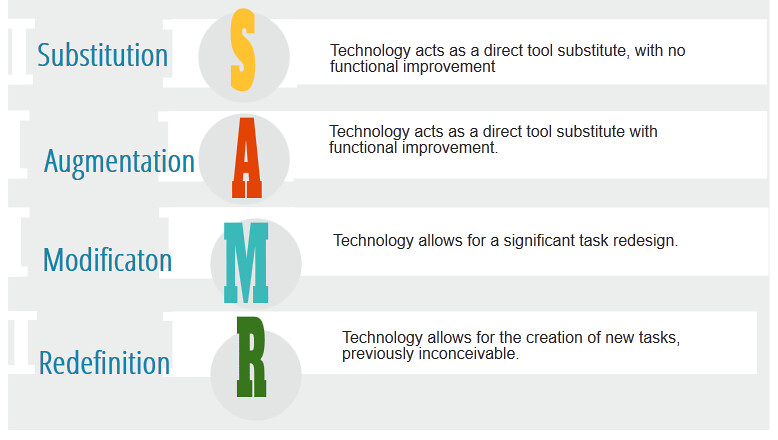
Recently, I was googling (creative commons free) images of the SAMR model and saw these images;


I could not help to question.....2 weeks later and I am making my own meme.


Why SAMR is like ordering 'pumpkin spice'.

  1. There is no research behind it. This shocked me. I have seen SAMR all over the show, at conferences, in publications and referenced by people I respect. How could it be that a model so widely used has no research behind it? What is confusing is watching Ruben Puentedura (the creator of SAMR - yes he has a PHD after his name, but for Chemistry - not Education) talk. He mentions research throughout, even stating that "redefinition tasks can improve student outcomes by as much as the equivalent of roughly 2 letter grades"..... the study that shows this 'jump' is unseen, like all of Mr Puentedura's research. Equally unfortunate is that he simply states 'student outcomes' without defining what student outcomes means. Does it mean progress, engagement, ability? Research from other people is cited in his talks, which is genuine, such as having an authentic audience improving student motivation, but no research is available that shows the SAMR model improves student outcomes. Without research, I think it gets relegated to an idea, not a model. 
  2. It is misunderstood. Countless examples of the interpretations of SAMR are around to the point that I do not even know what the correct interpretation is. I have watched Ruben Puentedura describe SAMR as a ladder model, with the end goal to reach redefinition. I have seen it being used as a planning model, with teachers assessing what 'level' of SAMR a learning activity or (gulp) App is. I have always thought of it as more of a 'check in' - something for teachers to consider, mainly to ensure they are not always at the 'substituting level'. By definition a model is something others can follow and we have no shared understanding about what SAMR is about.
  3. What is wrong with substituting? At times, substitution is fine, possibly essential. We may want to take notes on a device so we don't lose them or so we can copy and paste them into another tool at a later time to further analyse key ideas. Or we may find it quicker and more convenient to read a book on an eReader. The point is, there is no point analysing what 'level' a task is, as there is a time and place for all learning tasks.
  4. What is so great about redefinition? By definition, a redefinition task is a task that was 'inconceivable' before the tech. So that means cyber-bullying would fit great into redefinition, as would re-sharing cat videos on Facebook and messaging friends instead of visiting them. Newer is not always better. Sure, SAMR advocates would say 'of course these things are not redefinition - they are not even learning tasks' which is exactly my point. The model is not even about learning - it is about using technology. Which segways nicely into...
  5. Why are we placing technology on a pedestal? This has always bothered me. Why do we have a model that is supposed to 'level' a learning task only apply to learning with devices? Can other tools 'redefine' learning? I have seen some amazing Enviro-School projects that allows for tasks 'inconceivable' without a school vegetable garden. Are these tasks as important? Do we need a model to show 'types of Enviro-School tasks'? Would it improve our collective abilities to use school vegetable gardens if we did? 
I think the SAMR idea is an OK reflection 'tool' for teachers, whereby teachers can look back at their technology integration over a term/year and reflect on their use of technology. Has it always been simply substitution? Or has the technology gone beyond simply replacing 'pen and paper'? 

Until some serious peer reviewed research occurs, I believe we should focus on a more simple model - "Use technology purposefully'.

References

Monday, July 6, 2015

I have been binge thinking about #bingelearning

While writing my 'Neflix Generation' post I become more and more interested in the concept of Binge Learning, so much so I decided it needs its own post...

What is Binge Learning?
To define Binge Learning, you first need to define binge-watching. Cue Wikipedia; "Binge-watching, also called binge-viewing, is the practice of watching television for longer time spans than usual, usually of a single television show". Therefore my definition is;


Binge Learning is the practice of learning content for longer time spans than usual. 


When is Binge Learning effective?
Binge learning is usually not 'cramming for an exam'. The difference lies in the why you are binging. I once watched the BBC for 4 hours while waiting for a plane - why? I was a captive audience, there was no other channel. Binge learning should be something the learner is fully immersed in - they do not want the learning to end. 

By definition, Binge learning is any learning that continues for a longer time than normal. It may be as simple as flagging writing as the students are so gripped in solving a question in maths - or as complex as an entire term in a completely integrated topic about 'flying'.

So, why Binge Learn? 

  1. Binge watching and learning means you do not forget what happened last time, making the viewing/learning more enjoyable. 
  2. It allows for more complex storylines/learning. If a viewer/learner has to wait a week between shows/lessons the emphasise then becomes on either catching them up with the action or having episodes/lessons that sit in complete isolation (they can be viewed/taught without any previous knowledge). This leads to shows and lessons that are, to be kind, simple. One off shows/lessons may be enjoyable enough at the time, but you are probably not likely to lye awake at night thinking about them!
  3. Binge watching/learning is more exciting as you know your learning/viewing will not come to an abrupt stop. I feel this allows you to 'let go' more and become emotionally invested in the viewing/leaning.
  4. Time is not an issue. So often in our learning, time becomes a barrier. It may even be the reason we use to many closed and not enough open questions in our teaching. Binge learning allows us to throw away the clock and focus on the learning - no matter how long it takes. Not worrying about time also allows students who may be slow to pick up a new concept - but fast to apply concepts learnt - a chance to succeed.
  5. Better lesson design. Often our lesson planning restricts around chunks of time, so our thinking as to possibilities stays within these windows. Planning for Binge learning means we can get more creative - we can allow for more options for students and free ourselves up to support individuals more effectively. One of the aspirations of Binge learning should be to have students emotionally invested in their learning. To do this, we need to plan exciting and relevant tasks. Binge lesson cannot truly occur with worksheets!
Want to set up Binge Learning for you students? The conditions to help make Binge Learning happen are;

Content that is relevant and engaging ....to the point that the learner is emotionally invested in it. To really have the learner emotionally invested, you may need to have a 'so what' or 'action to take' outcome in your learning. 

The content is all there for the learner. Binge learning can not take place with a worksheet. Why? Worksheets end - like an old school TV show. Just as Netflix releases the entire season of a TV series, we need to release entire 'units of work'. Giving learners all the content at once would have created a huge 'paper monster' with 30 'baby paper monsters' in the past. With the advent of devices, content can now be made available through a series of online resources that students can navigate through at their own pace. 

Take them on a journey. The most popular 'binge watching shows' are those that have story-lines that flow into each other like chapters in a book. Likewise, to design Binge Learning we need to 'map out' the learning. Pose some questions or a problem, alongside some tools and resources that will guide thinking. Watching TV is not as fun when you know what happens - likewise telling the learner what is going to happen (and when we finish you will make a video about ...) is not as gripping. 

Saturday, July 4, 2015

#bingelearning. The Netflix Generation.

Recently I realised that I had not watched more than a few hours of live TV all year. Only 5 years earlier I would have returned home from work to turn the TV on in time for the news (OK - maybe Home and Away at 5:30...) and the TV would have been on until I went to bed. Where has the 5 hours+ per night of TV watching gone? I would love to say solely into more productive pursuits, but mainly it has gone to Online TV streaming services. The interesting (exciting) thing is my 5 hour a night habit is now more like a 1 hour a night habit. I genuinely look forward to it and actually gain pleasure from it - a big shift from the 'flick through until I found the best of whatever's on' years.

I believe there are some parallels with teaching to my (our) new TV viewing habits;


Modern TV Watching
Modern Classroom Learning
Binge Watching. Viewers becoming so engrossed in a show they continue it for the entire day/week rather than stop watching after 45 minutes to move onto the next show.

Binge Learning. Students becoming so engrossed in a concept they continue it for the entire day/week rather than stop learning after 45 minutes to move onto the next lesson.

Flexible Viewing. Viewers watching content when it suits them through the use of on demand services. They can pause, rewind and repeat shows through the use of technology.
Flexible Learning. Students learning content when it suits them through the use of flipped classrooms and flexible timetables. They can pause, rewind and repeat learning through the use of technology.

Passion Viewing. Viewers get deeply involved in the shows they watch - they follow news feeds about them, tweet and blog. They make connections with other like-minded individuals to deepen their understanding of the show (e.g. GoT fever)
Passion Projects. Learners get deeply involved in the lessons they engage in - they follow news feeds, tweet and blog. They make connections with other like-minded individuals to deepen their understanding of the learning.

Personalised Viewing. Viewing habits are monitored and suggestions and recommendations given based on their individual interests and history of shows watched. Feedback after each show is seeked to better understand the viewer.

Personalised Learning. Students learning is monitored and suggestions and recommendations given based on their individual interests and history of learning. Feedback after each lesson is seeked to better understand the learner.

Viewer Agency. The viewer has choice in what they watch - they are not restricted to what’s on - they can make their own decisions around their viewing. The viewer is able to use technology to create their own show and share with the world.  
Student Agency. The student has choice in what they learn- they are not restricted to what’s on - they can make their own decisions around their learning. The learner is able to use technology to create their own lessons and share with the world.


2014 Study...

Chart: Traditional v online TV

Sunday, June 21, 2015

Digital Badges - Part 1 of 3. Setting up Digital Badges.

This post is intended to be the first of three posts about Digital Badges. 
Part 1 is the 'How' Part 2 the 'Why' and Part 3 the 'Outcomes'. I am writing the 'How' before the 'Why' as I am still grappling with an idea - "Do Digital Badges led to extrinsic motivation and fixed mindsets'? (would love anyone's opinion on this)....

Digital Badges are 'Brownie Badges for your Blog'. They could be for any achievement; from completing Triathlons to Learning a musical instrument. Here is my recommended process of how students can earn these badges.

1) Explain the concept of Digital Badges to your students (maybe bring a Girl Guide/Brownie/Scout uniform to show 'old school badges') Have students brainstorm a list of what badges could be awarded for. This list does not have to be definitive. I had 3 criteria for my students;

  1. It has to be an achievement that is accessible to anyone i.e. winning a musical scholarship for 10 year old is accessible to all 10 year olds as any 10 year old could apply. Riding the tallest rollers coaster at Disneyland is an achievement - but not everyone has the opportunity to do this.
  2. It has to be able to be self-managed by students. By this I mean students need to be able to know if they have achieved this, so a 'kindest person in the class award' is not appropriate as it would require others (teacher) to determine. Having 20 'gems' in your writing book can be self managed though, as the teacher indicates these in their feedback and students can count them.
  3. It has to be measurable. 'Being good at cricket' is not measurable. 'Being in a Rep Team for cricket' is.
2) Have student make badges. I used www.openbadges.me as it works with our students iPads and Chromebooks and is pretty easy. You could also use Google Drawing or Paper and Pen (then take a photo). You only want one student making each badge, so have students write their name or cross out ideas as they begin to create their badge.

3) Store badges in a shared location or have students share badges with you. This is where my method splits into 3 methods.. 
Method 1 (quick and easy) is to have all the badges stored in one Google Drive folder that is shared with all students. 
Method 2 (requires some work from the teacher - but may be essential) Is to have all the badges, along with a description of how to achieve them, on a Class Website/Blog.
If you are all about quick and easy jump down to Step 5!
Method 3 (slower, but with more transparency) is to have students share the badges with you, then....

4) Create a Google Form for each badge. See the form example below. The main purpose for having a form is so a teacher can look at the 'Google spreadsheet' that the form automatically creates and quickly see students that have been awarded badges. The Google Form collects students login name, adding extra transparency to the process. Overall, I feel that the form makes students take more responsibility than simply having a folder they can access and download badges from - but really depends on the students as to what method to use!

Forms would then need to be embedded or linked from a central location (your class blog/website) for students to see what badges are available.
Here is a link to a live form to see how they look.

5) Let students Save the badges and upload to their Blog. At any time, students can go to the shared folder or Blog/Website that hosts the 'Badge Forms' or 'Badge Images and descriptions' and save/copybadges. They will then need to upload/paste the Badge Image into a Blog Post or Digital Portfolio.

My expectation is that some reflection needs to be included when students post their badges to their own blog. e.g. "Here is my Eco-Warrior badge for being part of the Eco-Warrior team in 2015. I am proud to be in this team as a lot of students wanted to be in it. I am also proud because I think the work we do is really important, like composting and recycling".

Tuesday, June 16, 2015

Embed a Google Drive video

Videos are so important in sharing learning. I have found the most effective video sharing tool to be Google Drive as;


- It is really easy to add videos to Drive from any device - including iPads and Chromebooks
- Videos can be shared with others easily (i.e. a video project can be shared with each member of the group)
- No 'related videos' that appear to the side and at the conclusion of your video (like on YouTube)
- Can be embedded just like a YouTube video. 
This last statement does not seem possible at first, so here are my 5 steps to embed a Google Drive video into any website.
  1. Go to Drive and open the video (it will open in a preview mode)
  2. Once the video is viewable - Click the open button (this will open the video in ‘full’ mode).

3) Click the Share button (persons head) and ensure that other people can see your video. By selecting “Anyone with the link can view” only people who have the exact url will be able to view.


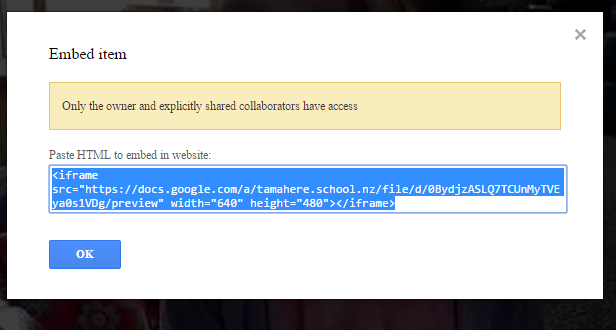
4) Click the Menu Bar (3 Dots) you will click on the “Embed Item” option.


5) Copy the embed code (click once and the whole code will be selected, then COPY).


On an iPad you  need to go to drive and click the info icon next to video.
Then click on Get Link - it will copy the URL link.
Then paste this link into a browser (Chrome).
You can then get the embed code the same way.
A little harder, but works well.

Tuesday, April 7, 2015

KidBlog Version 4 - Review

OK, so we are potentially in the minority of schools in that despite being a GAFE school who live within the Google EcoSystem, we do not use Blogger, instead we use a blogging platform called Kid Blog. I would like to complete a direct comparasion between Blogger and KidBlog at a later date, but for now I am going to present my initial impressions of KidBlog's new platform. 

Good:

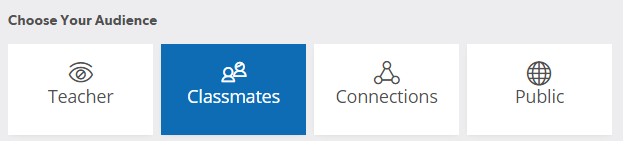
    1. Publishing options. KidBlog is now unique amongst the major Blogging platforms in that every post a user makes gives the blogger up to 4 publishing options, depending on what options the teacher has allowed.

Teacher
Classmates
Connections
Public
What
Need to login to view, then only the teacher, student that has posted and any connected parents can view.
Need to login to view, then students in the class can view.
Need to login to view, then students in all connected classes (i.e. within the school) can view
Does not require login, just need to go to correct website to view.
When (suggested use)
Personal goals - assessment
Most posts from students. Posts from teachers that include student photos etc.
All Teacher notices for parents and students.
Student posts that require a larger audience


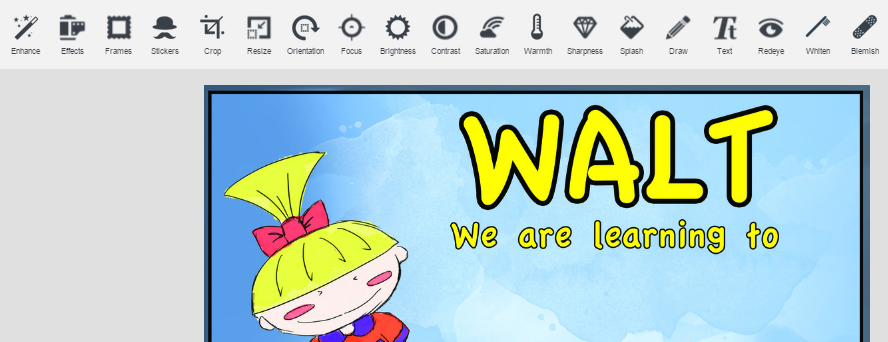
  1. Media Library and image editing. Our students were very engaged at this great update. Images can now be edited within KidBlog, including overlaying stickers and text, adding borders, cropping and enhancing . The below image is in my media library, so I can quickly insert text into the graphic.


  1. Google Drive integration. KidBlog has always been a winner in my mind due to its integration of Google Drive. Past version have been temperamental in allowing instant embedding, but this appears to have been perfected. What does this mean? That any Doc, Presentation, spreadsheet, PDF, image and video can be inserted into a post with 1 click.


  1. Post to multiple blogs. Post Broadcast has long been a popular feature of KidBlog. This great feature is now simply ‘Add to another Class’ meaning any post can be added to any blog the poster is a member of. Teachers can use this to post notices or learning links syndicate or school wide, while students can use this feature to add posts to other blogs they are members of, such as the Enviro Club or Maths Group.


5. Mobile Friendly - for any device. I have always appreciated that Kid Blog has a native IOS App, especially for inserting photos and videos directly into Kid Blog. This App has now been superseded by the KidBlog website been completely mobile friendly for any device. This means users are not restricted to a certain device, allowing me (for example) to take photos with my Android Phone within KidBlog and upload into posts.


Bad/Unsure?:
  1. Historically I have vouched for KidBlog's great support. With the advent of their latest update it would appear that their time is being taken up in ironing out issues with Version 4 and not responding to individual user issues. I would like to think their support will be back to its high level in the near future.


  1. Administrator options. In Version 3 an administrator had a lot of options - from resetting teacher passwords to changing the author of a post. These privileges appear to have been simplified with Version 4.


  1. Ability to only show posts from Admins/Teachers only on the front page. This was a great feature of previous versions of KidBlog, basically allowing only teacher postings to be displayed on the landing page. I liked this as notices, learning links and workshops were always visible to students and parents, whereas now they can be overseen by students postings.


  1. Group posting. There is still no way of groups that work together posting to all their blogs at once - or a teacher to post to another students blog. This creates a ‘double handling’ situation for me, where a collaborative video that multiple students have worked on has to be posted by every student in the group, rather than a ‘copy’ type feature where members can add other students who have contributed (yes, I know about tags and categories but I save these for other classifications - not users). The ability for a teacher to post to a students blog is also still missing - something that would make the portfolio process so much easier, especially in the junior years.


  1. Notifications. Email notifications for teachers and connected parents when posts and comments are not (yet?) available. For the teacher that does not use Kid Blog day in day out, this is problematic, as students may be posting without their knowledge. It also takes away one of the greatest benefits for parents of being alerted to new posts.


Conclusion.

The features KidBlog have included with this update are next level. Some I had never thought of, but immediately made sense, while others I had been hoping for for a long time. The current problems are hopefully teething issues as the new version is still in BETA testing. Ka pai KidBlog :)

Related - Why I like KidBlog

Monday, March 2, 2015

Your device is not a typewriter...Moving on from Publishing

The importance of the SAMR model lies within moving on from the purely 'substitution' level where a book is replaced with a device to higher levels of thinking where devices enhance learning beyond what is otherwise possible.

My first term teaching Year 1 and 2's I had a 'publishing' cycle going on for weeks - and most students never finished their initial story. As we had limited devices, students using them as typewriters resulted in others not being able to use devices to enhance their learning :(

Publishing on a device with students incapable of typing 10+ words a minute (usually 5 - 7 year old's) is a poor use of everyone's time - and obviously at the substitute end of the SAMR model. 

But, I had a vision of their stories being on the wall, in books for their classmates to read in the library and in the school newsletters. I wanted parents and our older buddy class to read our stories on our blog and give us feedback. I wanted Nana's around the world to read and - most importantly - I wanted the kids to know they were authors.

So, how to publish Junior writing to reap rewards without the pain?
  1. Adult (Parent) or older student helpers. Obvious, but often underutilised. Most parents run away from fundraising and working bees, but getting to take home 10 books to type up in the comfort of their home is far more palatable. If you are lucky enough to organise some typists, I recommend them typing up stories in Times New Roman with no formatting, so students have some ownership by changing fonts, adding titles etc. I also once had a group of keen Year 5 - 6s come in one lunch a week to type a few stories each.
  2. Using photos/scan of students work for blogs. If possible, take the time to teach them to take their own photos! At least once a term I used to have my class bring any learning they were proud of to the library photocopier and let them scan away. We would then post our proud learning moments to blogs.
  3. Have students select one or two 'gems' of sentences to publish themselves, which they can then type themselves. This is a great method when you want to surround your walls with effective language. By only selecting one sentence, your walls will be filled with rich language not "I went to the..."
  4. Use voice to text Apps. Honestly, I wish this was the only idea in this list, but the truth is I have never had great success with them, to the point that I would not recommend any I have tried, but if you know one that works - good for you (and please tell me!)
  5. Don't type - record! Is a story made into a multimedia visual extravaganza still a story? I think so. Use Apps like Puppet Pals, Book Creator, Adobe Voice or Sock Puppet. Or record students using whatever video/audio recorders you can find. Creating these text-less medians is great for blogs - but not for your walls. My solution to this? QR codes and with book/movie covers on the wall.
Yes, to collaborate, question, discuss, critique and evaluate content, the content must first be made available. Allowing the time to be spend at these higher level activities and not the typing is the message.

Tuesday, December 16, 2014

Top 5...Ways to shorten an Apps Wishlist


One of the exciting/daunting tasks of rolling out our BYOD programme was giving parents a list of Apps to download for their students iPads. When googling various schools lists, I got a shock that some lists came in over $100 and looked like they would leave little room on a 16GB ipad for media content.

Our aim in keeping our list short was wanting students and teachers to maximise the full potential of a few Apps rather than skim the surface of 30 odd Apps.

Enough people with more knowledge than me have shared lists of 'the best Apps for schools'. Here is my list of how to shorten these 'wishlist' of Apps.

1) Workflow. Workflow with any device is crucial. I was once at a school where a student proudly told me about a video they created. When I asked to see it, they said the video was on iPad #7. This is a direct response to not thinking through the workflow of Apps. 

All content created on an iPad should be able to be shared - with or without the original iPad it was created on. The answer to ensuring good workflow is ensuring your Apps work with;
-Your LMS/blogging platform App 
- Web Storage App. For us, this was Google Drive.  Google Drive is our go to App to save photos and videos.

 I am surprised at how many Apps do not produce embed code to add to blogs or upload options other than taking a screenshot.

2) Integration. As a GAFE school, we prioritised some Apps over others due to Google Integration, other Apps were winners as no sign-in and passwords were required. Apps that required users to be 13 and older / use Facebook to sign in had to be put to one side.


3) Avoid Duplicates. No school App list should contain Apps that achieve the same purpose. Obviously, all Apps have slight differences, but think about why you would use the App and if another App achieves this on your list. For us, Explain Everything,iMovie and Book Creator for iPad take the place of alot of Apps!

4) The Substitution Test. I do not believe that all Apps fit nicely into the SAMR model, in fact, give me any iPad App and 10 minutes of quiet thinking time away from kids and I could think of a possible Modification or Redefinition task. 

Where we did use the SAMR model was the Substitution test - are we just substituting something we already successfully do with an App? We have great hands on maths equipment, do we really need fake alternatives when we have the real thing? Likewise, our kids successfully gather around big bits of A2 and mindmap collaboratively. By each sitting in their own space and mindmapping on their own device, is the learning really enhanced?

5) Play, Test and Check! Sometimes, I download an App, play, and fall in love. "It is essential!" I tell myself. 

Then, I test it. I use it as it is designed to in the classroom. I start a task and complete it in its entirety, right down to posting the finished content on a blog. Only when wanting to post an Adobe Voice did I discover I had to have an Adobe account - and that I had to be 13 and above to do this. Likewise, some Apps respond well with limited text or images, bit soon 'run out of screen space' or lag. In my testing phase, I try to involve students, who often tell me things I never thought of - like "the web version of this is way better" or "I just use this other App (I already have) to do the same thing".

My final task is to check about all the things people complain of. Is the keyboard consistently responsive within this App? Can you easily navigate? Does it close off every time you attempt to save a video?


With all this in mind, here is our current 2015 Year 5 -6 iPad App list. Feel free to leave a comment about 'the best App' that we have not included! 


Monday, December 8, 2014

Top 5...Creative Christmas card ideas.


1. QR Codes. QR codes are awesome. The possibilities of using QR Codes with cards are limitless. I would recommend using Adobe Voice to record students singing a song or wishing someone a Merry Christmas. When you upload to Adobe, you can generate a QR code. Or, if you are time short, have your students select something they created earlier in the year and are proud of to generate a QR for. I use the goo.gl  Chrome extension to generate codes.


2. Photo montage/collage. Mums and Dads always love photos of their kids. Jazz things up by using a fun App like PicMonkey (Chrome) or Pic Collage (iPad/Android).


3. Scratch Holiday Card. Coding is essential for all students to learn. I love having students carry out a fun activity like this and getting them hooked on coding.
    4. Word Art. Years after first using, I still love the look of Taxego. One of the classes I release created a choice word cloud for their teacher by adding adjectives to describe her in a shared doc. I then copied and pasted into Taxego and we collectivity decided on the best colour and shape options. 


    5. ReciteThis is a great tool to add your Christmas message to and instantly turn into a beautiful card. 

Tuesday, December 2, 2014

Top 5...Reasons I like Kid Blog

UPDATE - KidBlog have a new version of their platform. Check out my review here


  1. Post Broadcast. As a teacher, I can broadcast any blog post to any other class in the school - read that again and think of the possibilities.....cutting down the workload anyone?


  1. Ease of Use. Our 6 year old's use Kid Blog, mainly due to their simple login system where users select their name from a drop down list, then type in their password or click the 'Login with Google'...The Apple App (need to keep the list to 5, so will throw into Ease of Use) is simplistic yet covers everything you need - including shooting video or using the camera from within the App.


  1. Google integration. Login's through Google and 1-click posting of any content from your Google Drive account makes Kid Blog integrate better with Google - perhaps even better than than Google's own Blogger!


  1. Customisable. From students selecting their own themes to teachers selecting how they want to modify comments, Kid Blog have a lot of options!  
  1. End of Year 'Transfer'. I have been reading about the dilemmas some schools are currently having with what to do at the end of the year with students blogs - after all, does a child really want to continue with the same blog they started as a 5 year old into Intermediate - how lame. Yet, what a waste to completely forget about it. With Kid Blog, each year a child's account remains open, you simply add them to additional classes (blogs). They get a clean slate at the start of the year, but (big but) they have a nice drop down menu where they can flick back to other years and reminisce :)


My Wish List (Yes Matt, I really want these things)
- For teachers to be able to post to students blogs (As a teacher) to praise, add a photo etc. This would be tumeke for Junior classrooms completing eportfolios.

- A KidBlog Android App - for my Galaxy Tablet!

- A KidBlog Chrome App, so we can all have the KidBlog icon in our Chrome Dashboards!